
Beyond The Balance Podcast
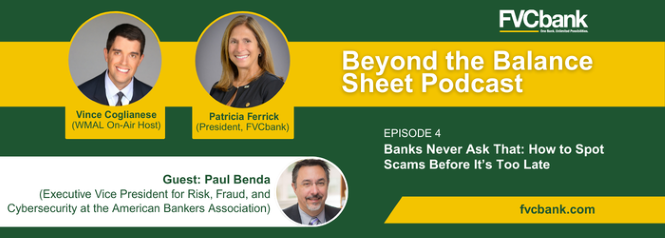
Episode 4 | Banks Never Ask That: How to Spot Scams Before It’s Too Late
Overview
In this episode of Beyond the Balance Sheet, hosts Vince Coglianese and Patricia Ferrick speak with Paul Benda, Executive Vice President for Risk, Fraud, and Cybersecurity at the American Bankers Association. Paul explains how rapidly evolving fraud schemes, fueled by artificial intelligence, deepfakes, stolen personal data, and large-scale global scam networks, are making it increasingly difficult for consumers to distinguish legitimate communications from criminal attempts. He highlights the ABA’s national efforts, including the “Banks Never Ask That” campaign, tools for information sharing among banks, and collaboration with government agencies and international partners. Through vivid examples, Paul details today’s most common scams, the psychological tactics criminals use, and the proactive steps banks and consumers can take to reduce risk. The episode emphasizes the importance of vigilance, multi-factor authentication, and rapid reporting, while also looking ahead to future challenges and emerging global cooperation to fight fraud.
Prefer reading over listening? You can read the full transcript of the episode below.
FVC Bank’s Beyond the Balance Sheet Podcast – Episode 4 – ABA
Vince Coglianese (00:03): Welcome to Beyond the Balance Sheet. This is the podcast where we explore how banking connects to people, businesses, and the communities that we serve. I’m Vince Coglianese
Patricia Ferrick (00:14): And I’m Patricia Ferrick. Thank you for joining us.
Vince Coglianese (00:17): Today we are joined by Paul Benda, Executive Vice President for Risk Fraud and Cybersecurity at the American Bankers Association. Paul leads the ABA’s national efforts to protect consumers and banks from cybercrime, and he oversees the popular Banks Never Ask That campaign, which helps people recognize and avoid scams before it’s too late. Paul is also the chair of the International Banking Federation’s Fraud and Scams Task Force, helping banks coordinate and fight fraud and scams all around the world, and will be representing banks at the UN Global Fraud Summit in Vienna in March.
Patricia Ferrick (00:54): Paul, welcome to Beyond the Balance Sheet. It’s great to have you here. Before we dig in, can you give us a quick sense of what your role at the ABA involves?
Paul Benda’s Role and ABA’s Fraud/Cybersecurity Mission
Paul Benda (01:03): Sure, Trish and thanks for having me. So at the ABA, you know, my group focuses on risk fraud and cybersecurity. So it’s kind of all in that title there. And really the two main pillars are fraud and cybersecurity. You know, we know that cyber-enabled fraud is a key piece of how people get lured into these scams. And so we look at how do we protect people’s bank accounts, how do we stop criminals from hacking into them, how do we stop people from being defrauded? And so we have education campaigns out there like our banks never asked that campaign. We build tools to allow our bankers to connect with each other. So if some of one of their customers experiences a fraudulent event, what banker can they contact on the other line to maybe stop the flow of funds? And then we’re building other ways that we can work with the government and the regulators on ways that we can better share information across different sectors, whether it’s with the telecoms or whether it’s social media companies or whether it’s other banks internationally.
The Evolving Fraud Landscape
Vince Coglianese (01:50): My impression is that the fraudsters are uh very nimble, that they’re very sophisticated, and that there’s constantly new and emerging trends that you probably have to be up to speed on. What are you seeing out there?
Paul Benda (02:03): Yeah, I think you know everyone’s heard of AI, right? We’ve all heard of the deep fakes that are out there, and that’s something that we’re seeing our customers experience, our bank customers experience. And so we’re worried about, you know, the grandmother scam. You know, this is one where a criminal will call up someone and pretend to be a loved one in distress, and now they’re even taking it to the next level where they’re spoofing their voice. So it sounds like your sounds like your loved one. We’re worried about impersonation texts that are being sent. We know of one small bank where they blanketed the entire market with fake fraud alerts saying, Did you make this Walmart purchase? And then all of a sudden the bank started getting all these calls. This is a three-branch bank. They got 600 calls in one day. And the the challenge that I don’t think people understand is these criminals now can buy a lot of your data online with all the data breaches that have occurred around the world. Uh so they’ll call you up and they’ll say, Hey, is this John Doe? You live at this address? Is this last four year social? I want to talk to you about this potential purchase. So the people think they’re talking to their bank because not only do they have that information, but the caller ID might even say the name of their bank and the number that the bank uses for their outgoing calls. And so it really is hard for consumers.
Psychology of Scams
Patricia Ferrick (03:07): It absolutely is. You know, we hear about social engineering all the time where criminals trick people, like you said, into giving up personal information or sending money. But why do you think it’s still happening at such a high level with so much information out there about it?
Paul Benda (03:23): Yeah, so I think it’s it leads with that technical authentication I brought up, that caller ID, the spoofing of the name, that personal information they’ve got. But remember, you’re dealing with a criminal industrial complex. These are not, you know, the Nigerian princes of yesteryear, right, with the bad email and the bad spellings. The State Department estimated that there are 400,000 people in camps across Southeast Asia that are used to contact and basically scam people out of their money around the world. 400,000 people. So you think of the scale that’s there, and they do this every day. So they’re very good at it. They know the right things to say, and they cause fear and they cause intimidation, and they they they actually take you out of rational state of mind and put you in that fight or flight perspective. And so they keep telling you, you know, if you don’t pay this fine, you know, you’re gonna lose your license. You know, you missed your jury duty summons, you’re gonna get thrown in jail. And so people just like, oh, I need to take care of this, I need to take care of this. You know, and at heart, people want to be friendly, they want to be helpful, they want to do the right thing, and the scammers play on that and they they basically instigate this fear into people and they make decisions that probably if they were thinking rationally, they probably wouldn’t.
Vince Coglianese (04:26): So in other words, like people should be on guard for anybody who’s who’s urging them to do something now. Like you should instinctively think to yourself, wait a second, pause, take a breath, and let me actually call my bank and talk to them first.
Paul Benda (04:39): That’s exactly right. There’s two things, you know, two two of the biggest red flags. One is if someone is is telling you to act quickly, that’s a big red flag. The other one is if it’s a secret, it’s a scam. If they tell you not to tell anyone that this is going on, it’s a scam. So those are the two things that we talk about. Uh but they’re hard to take yourself out of that situation because these guys are really convinced.
AI’s Impact on Fraud
Vince Coglianese (05:01): That’s amazing. Okay. So how is artificial intelligence uh changing all of this? I mean you you mentioned voice cloning, and we’ve seen things about fake videos being used to try and trick people. Are the scammers really diving into this like in a in a big way now? Is this kind of the dominant way that people are being scammed?
Paul Benda (05:18): You know, it’s it’s it’s a leading indicator for is what I would say. So we know the voice cloning is out there. What we’re seeing a lot is a lot of these deep fake videos. It’s really easy to do a deep fake of President Trump and put on there, hey, to get your stimulus check, you know, they’ll put an ad up on Facebook or a meta or other platform. Hey, to get your your stimulus check, you know, contact these people and then they try and get your personal information, your banking account information. So that’s where we’re seeing it is really, you know, people are pretending to be Brad Pitt, and Brad Pitt’s in trouble. He’s in the hospital and needs your help. Uh we know we’ve heard customers, um, banking customers have reported that a man sold his house and sold his truck and because he was going to get married to Miranda Lambert. And he needs you know, she needed the money for the wedding. Literally, this is one of the stories that we’ve heard. And so, you know, people believe these things because you know they don’t understand what AI can do. And then on the even worse side, you know, you might have heard how AI is being used to help people code faster and build better tools. Well, the scammers are adopting this. And so now you might have gotten all these texts that you say, hey, can we talk? Oh, hey, we had this meeting at nine. They’re automating all these now with AI SMS texts that are going out, and they’re doing that initial conversation using AI bots. And so then when they finally get someone who’s responding and engaging, that’s when the scammer comes on.
Vince Coglianese (06:30): You know, uh, if I can, there was a uh scam of this nature because it happened to somebody in my life. My dad’s a Marine, a general, and uh he’s got a long military career, but as he accrued that career, all of his biographical details keep appearing on the internet. Stuff about like family members, ages, where he his duty stations, so enough for a scammer to try and compile like, hey, this is a real biographical story. And so a scammer in some faraway country tricks some random woman in the country into thinking that she’s got a relationship with my father over the internet and that she needs to send all sorts of money to maintain internet connections and all these things. And then I found out this is a super commonplace scam, and it’s happening all the time at scale where just poor women oftentimes are being tricked into believing they have these long-distance relationships with con artists who are just stealing money from them. And it’s happening, it’s just so disgusting to see. And it’s and you’re seeing it all the time.
Paul Benda (07:26): Yeah, it is it is disgusting. I mean, these people are just evil, and and it goes to that she wanted to be helpful. She thought she was helping, you know, your dad, yeah, quote unquote, your dad, you know, maintain his internet, or wanted to help, you know, Brad Pitt, or you wanted to help these other people. And so they really they really do lure these people into a relationship. They’re not thinking rationally about it, and we really want to try and get them, you know. And I guarantee you, he was saying, don’t tell anyone about this. That’s that secret part. Well, you know, as soon as someone tells you to keep something secret, that’s a scam. You got to try and find someone you trust to have a discussion with. And and frankly, a lot of times your banker knows a lot about these. So don’t be afraid to have a conversation with your banker about these types of things.
Banks’ Frontline Defense Against Fraud
Patricia Ferrick (08:02): Well, as a bank president, I see firsthand how much happens behind the scenes to try to protect our customers, constant, vigilant monitoring and software tools, and customer outreach when we see things that look suspicious. So from your national perspective, what are you seeing banks doing to get ahead of it and to prevent fraud before it even reaches our customers?
Paul Benda (08:24): Sure. So this is something, you know, I think banks invest billions of dollars to protect consumers from fraud every year. And frankly, I think banks do a better job than any other industry. You think about it, when was the last time Facebook sent you a fraud alert? You know, banks do this, you know, customers get this every day. You know, banks are even calling up customers when a high dollar check gets written. We’ve had a big rise in check fraud, not as sexy as you know, some of these AI deepfake scams, but it’s been a huge issue with checks being stolen out of the mail. And we know banks regularly call customers and saying, hey, you know, this this big check came through, did you write it? And so I think banks are being a lot more proactive. We understand these impersonation scams that are out there. Uh we’re doing better training for our tellers to try and recognize these. Uh banks routinely look at accounts for transactions that are you know what they would consider out of the norm. Uh they try and put friction into that. What we mean is they try and you know, question the customer. You know, but but in the end, a lot of times it’s that’s the customer’s money, right? We can’t we’re a bank isn’t isn’t our job to tell you how to spend your money or where you can and can’t spend your money. We do our best job to say, is this something you really want to do? Is this you know an appropriate transaction for you? And if it’s legal and it’s appropriate and you know you’re of sound mind and body, we have to let them make that transaction. We do everything we can to try and raise those flags. In the end, it’s up to that customer.
The “Banks Never Ask That” Campaign
Patricia Ferrick (09:36): So let’s shift to banks never ask that. It’s such a clever campaign. It’s funny, memorable, and effective. So what inspired it and what did you hope to accomplish?
Paul Benda (09:48): Well, you know, when you talk about you know cyber scams and fraud and things like that, sometimes people’s eyes glaze over, at least my wife’s eyes glaze over when I try and talk about it. So we’re trying to figure out a way that we can educate people and have it be memorable. And so we decided to go with something something more centered on humor. And so the idea is, you know, would a bank ever ask you, do you wear boxers or briefs? You wear blue you know, do you believe in aliens? No. Is a bank going to ask you for that one-time use passcode? No, we’re not gonna ask you for that kind of thing. So, what are the things that banks will and won’t ask? We’ve done it in a funny manner. We tried to make it engaging. We’ve got Banks NeverAskThat.com. You can go play a scam uh quiz and test your knowledge and compare your knowledge with your uh with your friends and with your family. We’ve got some really funny um actors that have participated with some skits with us to try and just you know get people to pause. It’s really Vince is exactly what you said. You know, maybe they this would you know sink in. Hey, this is something I heard about. You know, this is something I remember hearing that you know that video about, and maybe think about it and maybe pull themselves out of that fight or flight syndrome.
Vince Coglianese (10:46): Yes. We all have to be way more cynical, don’t you think? Yeah. No, it’s like we just have to be on guard. It’s a it’s a great it’s a great thing to to train yourself to do. Now, it is, I would admit, pretty rare for a cybersecurity campaign to go viral. I don’t know how you even achieved that. This one did it. As the public responded, what kind of feedback are you receiving from the banks?
Paul Benda (11:05): So we’re getting really good feedback. We have uh we’ve had well over 2,000 banks that participate in this. We sent it across the country, we put in different whether it’s Facebook posts or whether it’s Instagram or whether it’s uh posts that are on X, and so we’re seeing a lot of engagement. One of the best stories that we’ve got is you know, we had one of the banks playing one of these reels in place uh up on their display, and one of the gentlemen that was in line actually saw that and recognized uh some of the items that we’re bringing up in that, and then actually when he went up to the teller, he said, you know, I think I think I might be getting scammed here. And he so he brought exactly what we talked about, he brought up to his banker, they’ve seen these types of things before. He’s like, you know, telling him the information, and actually it stopped the man from being scammed. And so that was really exciting for us to see that kind of feedback. Uh we partner with our ABA foundation that helps with a lot of amplification of these tools, uh, but it’s been really successful at least in in getting some knowledge out there. You know, there’s still a lot more to do.
Common Scams and How Consumers Should Respond
Patricia Ferrick (11:58): Can you give examples of the most common scams you warn about? And what should a customer do or consumer do when they get a suspicious message?
Paul Benda (12:09): Sure. Uh you know, and the and the thing is what we do, you know, Vince, you’re right. We got to all be cynical, frankly. Anyone that reaches out to you, you have no idea who they’re calling from or who they are. So a lot of these things we see coming through text messages. They try and start up a conversation with you. Um we see it coming, you know, it’s still get the phishing emails when it could look exactly like your bank. You know, AI allows them to enable perfect examples of legitimate websites with maybe a slight change that’s in the URL, and so they’ll direct you to try and fill in your credentials in there. Um they drill they really do try and impersonate whether it’s a bank or a U.S. government employee to try and give up um information. We see them try and say things like, Your bank is being investigated. Can you help us with this investigation? Oh, we need to make sure your money’s safe because the bank might try and take your money away, so you need to put it in crypto, or you need to buy gold bars. And so they create these elaborate schemes, and again, people are trying to be helpful. They want to be helpful, and unfortunately, the the scammers prey on that. And so we always try and do, you know, if it’s a secret it’s a scam, everyone’s pressuring you, you know, pause and take a step back. But if for some reason you do make a transaction, the first person you do is call your bank. Because they have the best chance of potentially putting a hold on those funds that are out there. Your bank can help you work with the FBI. The FBI is an Internet Crime Complaint Center, it’s IC3.gov. You can go and file a complaint there. There’s a thing called the financial fraud kill chain that the banks work with the federal government, with different regulators and different law enforcement where they can reach out to other banks, even banks overseas to potentially stop it. But honestly, every hour you wait after that transaction occurred, it means the odds of you getting that money back go down more and more and more and more.
Vince Coglianese (13:42): Yeah. It seems like one of the great technological developments of the last decade or so is two-factor authentication, where you have to like go to a separate device or somehow in order to confirm that you are trying to actively engage in this transaction. It does feel like that’s a good instinct in real life too. Because like I’ve known scams where like people reach out, they’ll they’ll create a fake email address for your boss, and then they’ll email you pretending to be your boss. Well, if you’re suspicious at all, if you see this and you’re like, let me just call them. That’s two-factor authentication. Call your boss separately and verify that this is a real conversation and not a scam.
Paul Benda (14:16): You’re absolutely right. I mean, that’s because someone calling you, like you said, you don’t know who it is that people can’t trust that caller ID. So you can’t trust what’s being presented to you. But if you make that call, if you call the number on the back of your card, and honestly, the best way to engage with your bank or with a large technology company like Amazon, use the app. Go directly through the app. You can go, you’re it’s a very secure login method. Uh, you know exactly the information you’re getting is accurate, and you can see, hey, wait, that transaction’s not there. I don’t have any Amazon you know purchase that’s you know on my account, and then you know right away that someone’s trying to scam you.
Vince Coglianese (14:49): That’s amazing. Uh so the campaign, BanksneverAskThat.com, uh, do you think it’s making a measurable difference? Are you detecting that?
Paul Benda (14:55): We do. We think so. I mean, we we had the example where we’re seeing you know someone that that recognized it. Um you know, the it’s such a broad problem that any awareness that we can bring to it we think is is going to move the needle. Yeah. Uh we know that the scam rates are going up. If you look at it’s really hard to know the scale of the problem we’re dealing with right here. Uh there’s no central point in the U.S. government to report it. But both the Federal Trade Commission and the FBI have said scams are going up 25 to 30 percent a year. Uh FTC estimated losses to scams because of underreporting could be as high as $196 billion. Now, that seems a little high to me, but even it’s let’s say it’s half that, $95 billion. If it’s going up 25% every year, it’s going up a lot. So anything that we can do to educate consumers to make them pause, take a step back, uh, we think is gonna is gonna be helpful.
Small Business Fraud Risks
Patricia Ferrick (15:38): For our small business owners listening, what advice would you give them about protecting their companies from fraud?
Paul Benda (15:45): So I would say one of the biggest losses that we see in small businesses is business email compromise. So what happens is you know, you’ve got a vendor that you’ve been working with, all of a sudden that vendor will email you, and it’ll might even come from their account and that says, oh, hey, we’ve we’ve started with a new bank. Can you please change the wiring instructions for your next payment? You know, Trish, you’re shaking your head. You you probably have experienced this at your bank with one of your customers. Vince, it’s exactly what you talked about. Two-factor authentication. Call up your vendor with the number you’ve used in the past. Hey, did you guys change your wiring instructions? And it’s amazing how many businesses forget to take that step. And then all of a sudden they’ll wire the money out. 30 days later, their their vendor will come back and say, Hey, we never got that payment. Well, like we said, hours make a difference reporting these. 30 days, it’s gonna be really hard to get that money back. That money is now gone, probably converted to crypto, probably gone overseas somewhere. So that you know, if I was a small business, that is my number one, you know, there’s all the other things you got to be aware of, but that is the number one thing is making sure that anytime you’re working with a vendor, any change to any payment, you verify with a number you’ve used before and make sure you don’t use any of the details in that email. Uh, I used to work at a small business. This actually happened at my small business. Uh, we actually had a criminal that hacked into our email accounts, was resident, was reading on the emails as they came in and responding in real time just to those emails that dealt with that payment. It was really creepy when you thought about it. So they’re very sophisticated. So, but the one way you can do it finally ended when our business ops guy walked down the hall to the managing partner and said, Why do I need to make this payment so fast? He’s like, What are you talking about?
Vince Coglianese (17:14): Yeah. And then, I mean, just imagine though, you actually get scammed and then money goes out the door, and the sinking feeling when you realize what just happened and your own role in it. So if you get scammed, what’s the first step? Like, so now you you’re going through the panic and you’re like, what do I do first? What do you tell people?
Paul Benda (17:32): So call your bank. So we’ve actually, I was sitting at home, 5:30 p.m. on a Friday. I like to have a Martini, and you know, because it was a long week, right? Got a call from through our 1-800 bankers. So this is a number we have up for our bankers when they need help for ABA. Came in, I’m like, oh, geez. So I answered the phone. And it’s like one of our call center people says, Hey, there’s a bank that wants to talk about fraud. I’m like, okay. And so the banker was like, oh my gosh, we had one of our people send a $185,000 payment to the wrong address. What do we do? And so we’re talking them through them. Okay, okay, here’s the bank. File the complaint with the FBI’s IC3. Okay, let’s reach out to the receiving bank that got this, let’s send them a hold harmless, let’s make sure we got the affidavits in place that that fraud occurred. And I will tell you, it took some time, but 30 days later, they got all that money back because they acted with it. It was probably about 24 hours earlier. They realized they make that payment. So the the chances of you getting that money back, you know, if you can do it in that first 24 hours, is really good, but it takes a really quick action. It’s a partnership between both the business that you know executed that, the partnership with the bank and law enforcement and others. And you know, there’s a chance you can get that money back, but you gotta be quick.
Everyday Cyber Hygiene
Patricia Ferrick (18:37): Does happen. We’ve had some nice wins. So I appreciate that. We’ve discussed how cybersecurity isn’t just a technology issue, it’s a people issue. What habits can individuals practice to stay safe every day?
Paul Benda (18:49): Sure. So I think you know, Vince, you brought it up multi-factor authentication. You know, a lot of people, it’s basically derigor now on logins for your bank account, um, for all of you know a lot of the big transactions that you have. Make sure it’s on all your emails. I mean, think about it, it’s pretty much standard now. I think Google and Yahoo have required it, but before they didn’t, and we were seeing once they, think about it, once someone hacks into your email, they have access to everything. Your multi-factor authentication sometimes gets to send an email. Um don’t reuse the passwords. So we see this a lot. Uh a lot of retail sites may not have the same level of security as your bank. We see those get hacked, and then they get your username and password, and then they figure out, oh, this username matches the bank username, and then all of a sudden they know your password, and then they might now send you a fake fraud alert because they’ve got your phone number from that account, and then all of a sudden they’ll say, Oh, can you verify your identity with this one-time passcode? Well, what they’ve done is they’ve logged in with your username and password that you reused. They use that one that one time passcode gets sent to you, and then they type that in and they have access to your account. So making sure that you’ve got that enabled on all your different accounts that are out there uh is really important. Make sure you’re not reusing those passwords. Uh and that is really, I mean, I think the the two keys, and frankly, you can’t trust anything incoming. I you know, I I hate to sound cynical. But you can’t trust anyone that reaches out to you because the voices can be fake, the numbers on the ID can be fake, they can fake emails that come in, all of those things can be fake. You only know who you’re talking to unless you reach out to them.
Vince Coglianese (20:11): You’re making me paranoid.
Paul Benda (20:13): Good.
Vince Coglianese (20:13): Everyone is out to get me. They are. That’s what I’m concluding from all of this. If there’s one thing, if you could recommend one thing to everybody who’s listening about their behavior that they could change starting today, what would that be?
Paul Benda (20:25): Uh if you don’t have multi-factor authentication on everything, uh put it in place. Um I think, you know, well, one thing would be make your phone the center of your security. Use pass keys where possible if you’ve heard of those, uh, where you link it to the biometric on your phone, because honestly, the phone then becomes the whole point is it’s a physical token, right? It’s really hard to hack that. If they don’t have that phone, they can’t hack your account. Now, you lose your phone, you’re gonna be in trouble. But you know, you can rebuild that. You just but that’s having one central point for your security is really important.
The Future of Cybersecurity Challenges
Patricia Ferrick (20:55): As you look ahead, what do you see as the next frontier of fraud or cybersecurity challenges?
Paul Benda (21:01): I’m really afraid of what AI is gonna do. Um it just from an automation perspective. We’ve already seen the deepfakes, we’ve already seen the the voices and the videos and those kinds of things. Uh I’m afraid that we’re gonna see bots that become very personalized. And so think about this. If I were to, I can, you know, there was a 2.9 billion record public data breach that occurred in 2024. 2.9 billion numbers, you know, face all that personal information that’s out there. I load that all up into a bot, and then I then use that bot to then contact whether it’s businesses or banks, and they’re trying to, you know, reset accounts. And so they’re trying to go through knowledge-based authentication to prove who they are. Well, they’ve got all the access to the information, it happens. Or we start seeing them engage with people in a much more uh conversational method to make the scammers work easier. Uh the US government, to its credit, has focused on crackdown on overseas scams. They started a task force on it, which we love, love the Department of Justice has done that. But we think the criminals are gonna realize, hey, I can replace just like our businesses are replacing people with AI, they’re gonna replace the scammers with AI. And you’re just gonna see people get inundated more and more and more. And it’s it’s I’m afraid it’s gonna create a breakdown in trust. And we’re all I’m you know, I’m already recommending don’t trust things that are incoming. I think it’s gonna get worse and worse and worse, and people aren’t gonna know who to believe. And that’s that’s when it’s gonna be, I think, a really big challenge for us.
Vince Coglianese (22:17): Now, on a hopeful note, after all that. What gives you optimism? What what what makes you think, you know what, we can handle this, all these emerging threats, it can be done.
Paul Benda (22:28): I will say, you know, I’ve been at ABA eight years. Um I’ve never seen such a focus on fighting scams and fraud worldwide as I’ve seen lately. We talked about a UN Global Fraud Summit. Uh, we talked about the DOJ Stat Task Force, um, strike uh Scam Center Strike Force that’s going on. I was on a call with Canadian Bankers Association just this morning talking about how do we share bank contact information in case funds get transferred so that we can reach out to those bankers. We’re gonna build an international database of bankers so that if your funds go overseas, a U.S. banker can reach out to someone in the UK, Australia, Canada, other places to try and get those money back, and they can reach out to us. We’re trying to, the UK government’s leading an effort to try and figure out what are the baseline things that we should do to protect all citizens from fraud. And so I’m seeing a really strong effort here in the U.S. that’s starting to get underway. Seeing a really strong effort internationally to get underway. And AI is a dual-edged sword. We are building those tools into banks. We’re recognizing these changes, these anomalous behaviors faster that will hopefully help us stop. You know, the goal here is a shift to prevent that transaction from happening in the first place versus trying to get the money back after it’s out the door.
Patricia Ferrick (23:33): Paul, this has been a very eye-opening conversation. Thank you for sharing your insights and for all the work the ABA is doing to protect customers, consumers, and businesses in general.
Vince Coglianese (23:43): Absolutely. And for all of our listeners, you can explore so much more at BanksNeveraskThat.com, the super viral campaign. You’re gonna love it. Banksneveraskhat.com. It’s a fun and effective way to learn how to spot scams before they happen. That’s way better. Paul, thank you so much for joining us on Beyond the Balance Sheet.
Paul Benda (24:01): Thanks for having me.