
Beyond The Balance Podcast
Episode 6 |How Leadership Continuity Builds Trust and Performance
Overview
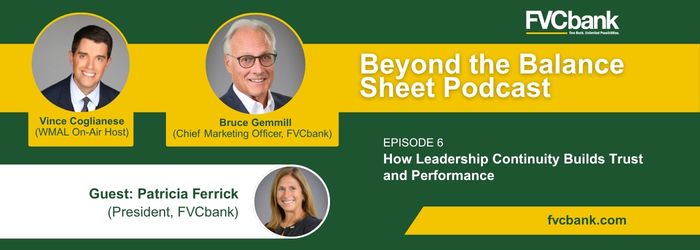
In this episode of Beyond the Balance Sheet, hosts Vince Coglianese and guest host Bruce Gemmill, Chief Marketing Officer, sit down with Patricia Ferrick, President of FVCbank, to unpack leadership continuity—the practice of carrying core values forward while embracing the right changes at the right time. Through clear examples and candid insights, Patricia explains why consistency in behavior and communication isn’t about resisting progress; it’s about giving teams a stable frame so change can happen responsibly.
Looking ahead to America’s 250th anniversary, we draw a powerful parallel between durable institutions and healthy companies: both endure by protecting the throughline of values and purpose while adapting to new realities. If you lead a team, steer a company, or care about institutions that last, this conversation offers a blueprint for balancing stability with evolution so trust can outlive any single leader or market cycle.
Prefer reading over listening? You can read the full transcript of the episode below.
FVCbank’s Beyond the Balance Sheet Podcast – Episode 6 – FVCbank: Patricia Ferrick
Framing America250 And Continuity
Vince Coglianese (00:04): This episode of Beyond the Balance Sheet continues our America 250 series exploring the values that shaped the nation and still matter today. As we look toward America’s 250th anniversary, we’re focused on leadership not as a moment in time, but as a continuum. How strong institutions preserve values, direction, and trust, even as people, markets, and technology change.
Vince Coglianese (00:29): Today’s conversation centers on leadership continuity. Our guest is Patricia Ferrick. She’s the President of FVCbank. Co-hosting today in Trish’s place is Bruce Gemmill, the Chief Marketing Officer with FVCbank. Trish, welcome.
Defining Leadership Continuity
Patricia Ferrick (00:45): Thank you, Vince. It’s fun to sit as a guest for a change.
Vince Coglianese (00:47): Well, we’re glad that you’re doing this today. When you hear the phrase leadership continuity, what does that mean to you, not just in theory, but in practice?
Patricia Ferrick (00:57): To me, leadership continuity is about building something sustainable and bigger than any one person. It’s the ability to maintain stable, effective leadership over time, especially during times of transition or change. The culture and values are always present and spread throughout the organization. In part that’s because collective leadership understands the mission and leads through example.
Vince Coglianese (01:20): So continuity is not about resisting change.
Patricia Ferrick (01:23): Exactly right. Continuity leadership provides a level of certainty that core values and the company’s purpose are intact so that change can occur responsibly. Change is everywhere, it’s all around us, and successful companies need to be able to adapt. In fact, I would argue companies need to embrace change and understand it’s necessary to achieve the greater purpose. But it’s the core values and mission that are constant and don’t change over time.
Consistency, Communication, And Trust
Bruce Gemmill (01:50): Trish, having worked closely with you over the years, I’ve seen how much emphasis you place on consistency and communication, especially during moments of change. From your perspective, what signals continuity most clearly to employees and customers?
Patricia Ferrick (02:03): Leaders that show up the same way every day, whether times are easy or difficult. Leadership is about communicating a clear and consistent message that both reassures and builds trust throughout the organization. The consistency is demonstrated over time and regardless of the changes, whether it’s uncertainties and fears of a pandemic or economic changes or changes in management.
Bruce Gemmill (02:27): And when that consistency isn’t there, when messages change or leadership goes quiet, what tends to happen inside an organization?
Patricia Ferrick (02:35): Unfortunately, confidence and trust can erode. Consistency isn’t easy. We’re all human and we have bad days, we have challenges, but ultimately leaders need to strive to show up the same way every day. Over the years, we’ve invested in leadership development for our management team, and one phrase we heard over and over again has stayed with me, and that’s leaders bring the weather. If leadership goes silent, sends mixed messages, or exhibits reactive behavior, it can undermine trust very quickly. So it’s critical to communicate consistent messaging often and with clarity, regardless of the circumstances.
Balancing Adaptation with Fundamentals
Vince Coglianese (03:11): Man, that’s for sure. Now you’ve worked really closely with FVCbank CEO David Pijor for almost 20 years, and you’ve led through multiple economic and regulatory cycles. How do leaders balance continuity with the need to adapt, especially during periods of real disruption?
Patricia Ferrick (03:27): Yeah, that’s a great question. And I have worked with David for a very long time, and it’s been an amazing experience. To answer your question, I think being consistent on the fundamentals that drive your company’s culture is non-negotiable. We have always been aligned in wanting a high-performing company that cares about its employees. So we talk about our core values often and how it defines who we are. Yet, as you pointed out, we’ve had to change to adapt to external circumstances over the years, and we’ll always need to adapt to stay relevant and be at our best. So it’s consistent reinforcement that change is necessary while keeping fundamentals the same.
Vince Coglianese (04:02): What breaks leadership continuity faster than anything else?
Patricia Ferrick (04:06): I’d say inconsistency between what leaders say and what leaders do, and an inability to demonstrate a vision or a path forward. We conduct surveys to get a sense of how our employees are doing, and it seems clear that feeling like you’re part of something meaningful and understanding the purpose of the organization is so important to employee work satisfaction. It gives employees confidence that leadership is moving in the right direction. So it goes back to leadership continuity over time, demonstrated by consistent words and actions, which drives confidence and trust and ultimately translates into performance, hopefully very good performance.
Continuity As A Long-Term Imperative
Bruce Gemmill (04:42): So in a time when many organizations chase disruption for its own sake, you’ve consistently emphasized continuity as a stabilizing force. Why do you think that idea matters so much right now, especially as the country approaches its 250th anniversary?
Patricia Ferrick (04:60): Because enduring institutions, whether nations or organizations, require leaders to always be looking ahead and understanding that some change is good and necessary. Continuity is how values are carried forward, not frozen in time. It’s how trust survives generational change.
Vince Coglianese (05:18): Well, Trish, thank you very much for this perspective. Leadership continuity is not just about holding on to the past, it’s about carrying the past’s values forward while allowing institutions to evolve responsibly.
Vince Coglianese (05:26): At a time when so much feels transient, the idea of continuity feels so much more important than ever. This conversation is part of our America 250 series, examining the leadership principles that allow institutions to endure across generations. Patricia Ferrick, President of FVCbank, thank you so much for joining us in this capacity on Beyond the Balance Sheet.