
Overview:
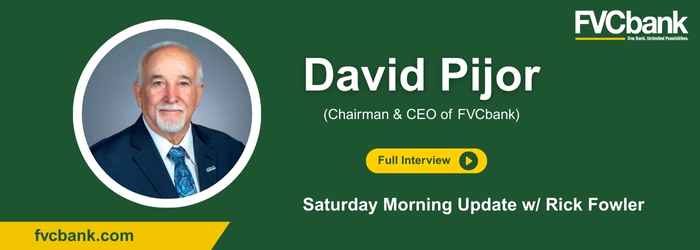
Following the Federal Reserve’s decision to hold interest rates steady, FVCbank Chairman and CEO David Pijor joined Rick Fowler on WMAL to provide a CEO-level perspective on what the move means beyond the headlines. Rather than viewing the pause as inactivity, Pijor describes it as a deliberate and stabilizing policy decision that supports economic predictability for consumers, homeowners, small businesses, and regulated industries. The conversation explores inflation trends, mortgage expectations, small business planning, and the evolving cannabis market in Virginia—highlighting the value of disciplined community banking in a steady-rate environment. FVCbank can be contacted at 703-436-3800 or through their website, FVCbank.com.
Transcript:
Prefer reading over listening? You can read the full transcript of the interview below.
The Fed Holds Rates Steady: What It Signals About the Economy
Rick Fowler (0:00): The Saturday morning update continues. I’m Rick Fowler. The Federal Reserve has just announced it is leaving interest rates unchanged. That reinforces the wait-and-see approach as inflation is continuing to moderate. Now, the administration has an opinion, the chairman of the Fed has an opinion, and we have what may be a more unbiased opinion from David Pigor. He is the chairman and CEO of FVCbank, and he’s got a CEO level interpretation of what the decision really means for consumers. It’s not politically motivated. What does it really mean for consumers, small businesses, savers, regulated industries, including even cannabis? Rather than focusing on the headlines, we’re going to talk about stability, planning, and disciplined banking in a steady rate environment. David Pijor is the chairman and CEO of FVCbank. David, great to have you back with us on WMAL.
David Pijor (1:04): Rick, thanks. It’s a pleasure to be back with you today.
Rick Fowler (1:07): So, from your perspective, the Fed just announcing that it is holding the rates steady. What does that decision tell you about the economy and where we are as consumers?
David Pijor (1:19): Rick, this generally anticipated decision means to me that the Fed is in evaluation mode as it considers the trajectory of our national economy in light of the Fed’s dual mandates to promote full employment and to manage inflation to its target rate of 2%. Fed Reserve Chair Jerome Powell told reporters on Wednesday that labor market indicators suggest that conditions may be stabilizing after a period of gradual softening. And in fact, the national jobless rate slipped to 4.4% in December from 4.5% in November. However, the central bank did leave its benchmark overnight interest rate the same after two previous quarter point reductions. I think what this suggests is that the Fed is focusing on stability and trying to be constructive in granting our business customers some level of stability in this market.
Stability vs. Stagnation: Why a Pause Is Still Active Policy
Rick Fowler (2:18): So, there are people who will hear the words no change and they may think that nothing is happening in the economy, that everything is flat. Is that a fair interpretation?
David Pijor (2:31): It’s certainly one interpretation. I think my interpretation is slightly different. Holding rates steady is still an active policy decision and this decision allows the Fed more time in validating its progress or lack thereof on inflation. The last inflation numbers have come in a bit higher than the target rate, around 2.7% by one measure. And I think the stability associated with a measured approach by the Fed actually helps reduce uncertainty and thereby creates an environment of stability in which businesses can can operate more clearly.
What This Means for Homeowners, Buyers, and Retirees
Rick Fowler (3:06): So, what does this mean for homeowners, home buyers and even retirees?
David Pijor (3:13): Well, interest rates don’t change overnight, notwithstanding the Fed’s prior two quarter point reductions. Mortgage rates won’t drop suddenly even when the Fed does move again, and it’s anticipated toward the end of this year that the Fed overnight rate will drop. But this puts pressure on mortgage rates. They will drop in the future. They’ll continue to drop as we’ve seen over the last year as interest rates do moderate, as the economy continues its path toward strengthening and improving.
Rick Fowler (3:45): So, let’s look at it from a community bank standpoint. An FVCbank specializes in community bank loans. It’s a regional bank. It’s not a national conglomerate where you always end up getting automated response and AI trying to route you to the right place. How does the environment affect small businesses?
Small Businesses and the Value of Predictability
David Pijor (4:06): Well, stability is important for small business. Obviously, lower rate borrowing helps. But as important, if not more important, is the stability to make timely, important business decisions knowing that there is some stability in the market. I think that the Federal Reserve’s generally conservative and moderate position, albeit disapproved by some in the economy, is actually a help to many businesses in developing an environment in which there is some stability and predictability. And I think that’s valuable in and of itself. Obviously, most businesses, almost all businesses and consumers would like to see lower interest rates. And I think we’ll see that in the future as the economy continues to improve.
Banking in a Highly Regulated Industry: The Cannabis Market Outlook
Rick Fowler (4:53): The cannabis industry is growing in the region. You’ve spoken a lot about this and there is new proposed legislation in Virginia, which would open it up further. How does a steady rate environment affect banking in the cannabis sector?
David Pijor (5:10): Rick, it’s important to understand that even with the considered possible legislation in Virginia, the cannabis market will remain highly regulated, subject to inspection for quality, for contaminants, highly regulated, inspected by state authorities. Much as the cannabis market in Maryland and in DC are highly regulated and very compliant markets. This is not street-level dealers. These are sophisticated growers that are subject to an increasingly tight regulatory compliant regime. And that’s the only type of operators that FVCbank provides banking services to. FVCbank provides a comprehensive suite of products. As you indicated, Virginia may be changing its legislative structure as to cannabis. In 2021, Virginia legalized the medical sales of cannabis, but this year Governor Abigail Spanberger has indicated she’ll sign a law permitting up to 350 retail dispensaries licensed to sell into the adult-use market. Current legislation working its way through both the House and the Senate of Virginia suggests that this legislation will pass. Some estimates have a Virginia adult-use market estimated to be as high as three billion dollars. This would be a significant change to the local cannabis market, perhaps even more important than interest rate stability or even a reduction in interest rates. Your listeners may find this helpful to know what’s happening in Richmond and we’ll be following you closely as well here at FVCbank.
Community Banking in the DMV: Relationship-Driven Financial Support
Rick Fowler (6:56): Well, FVCbank is, as I mentioned, a regional bank. I consider that as a local bank in terms of being able to communicate with somebody that’s in my area that knows the needs of this specific area. So as we consider that, what do you say the takeaway is for listeners?
David Pijor (7:15): We believe that sound banking isn’t reactive and that stability when managed well is healthy. We believe that the Fed action represents a measured, considered decision as to what’s happening with the national economy, and I think all that is helpful to local businesses and consumers. We believe community banking, as I’ve told you before on this station, is key to successful and healthy local economies and small business. We’re happy to serve those needs in the DMV, and we think the relationship between banking and the Fed is strong, and we expect that that will continue to be the case in the future.
Rick Fowler (7:57): What’s the website address for FVC Bank?
David Pijor (8:02): FVCbank.com. Again, FVCbank.com.
Rick Fowler (8:06): David Pijor, he is the CEO of FVCbank. David, thank you so much for the update.
David Pijor (8:12): My pleasure.